Skip to content
RAWBURTZ ART / OBSERVATION / CONTRADICTION

Original artwork

UNRESOLVED DISTANCE

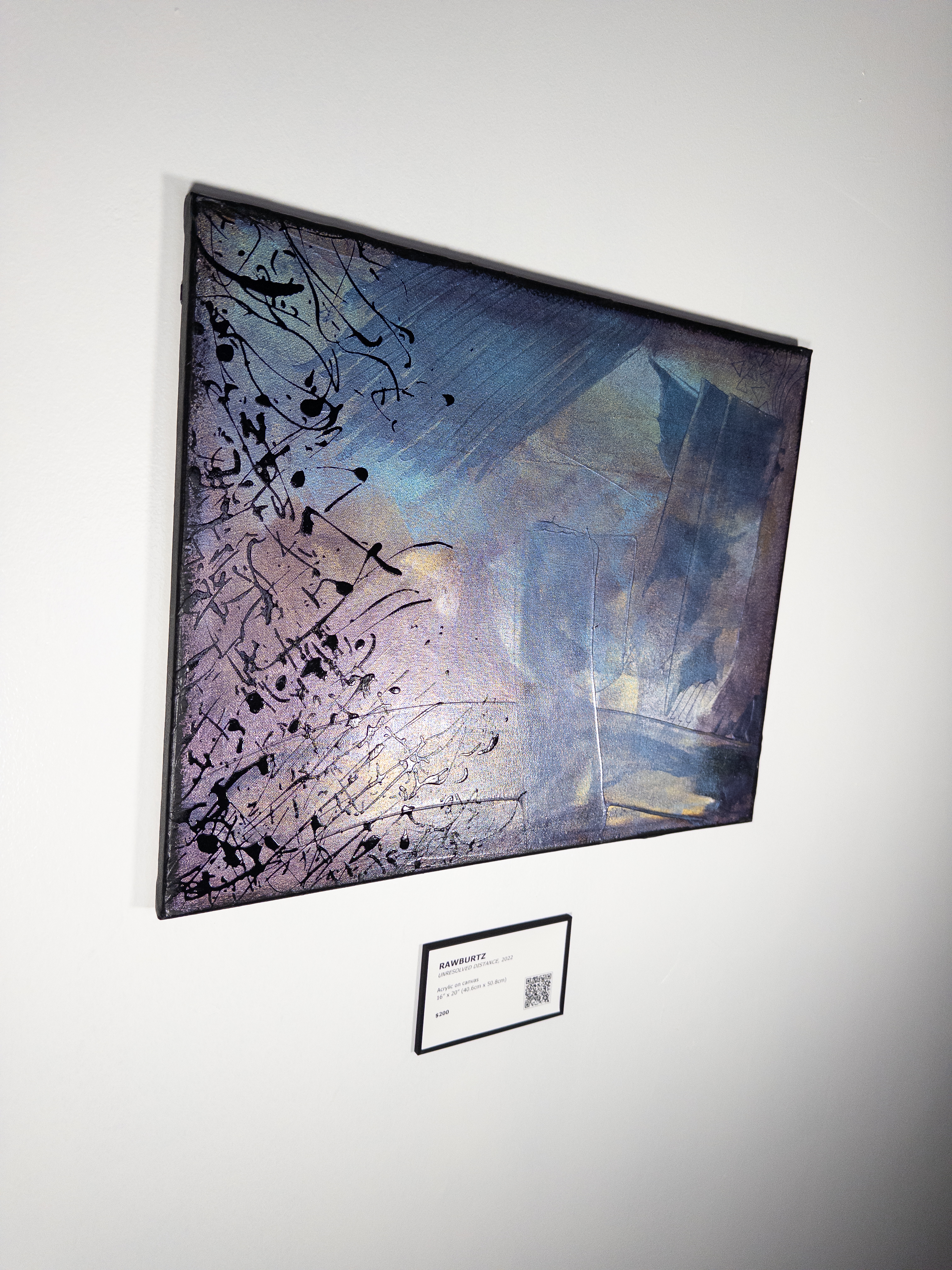
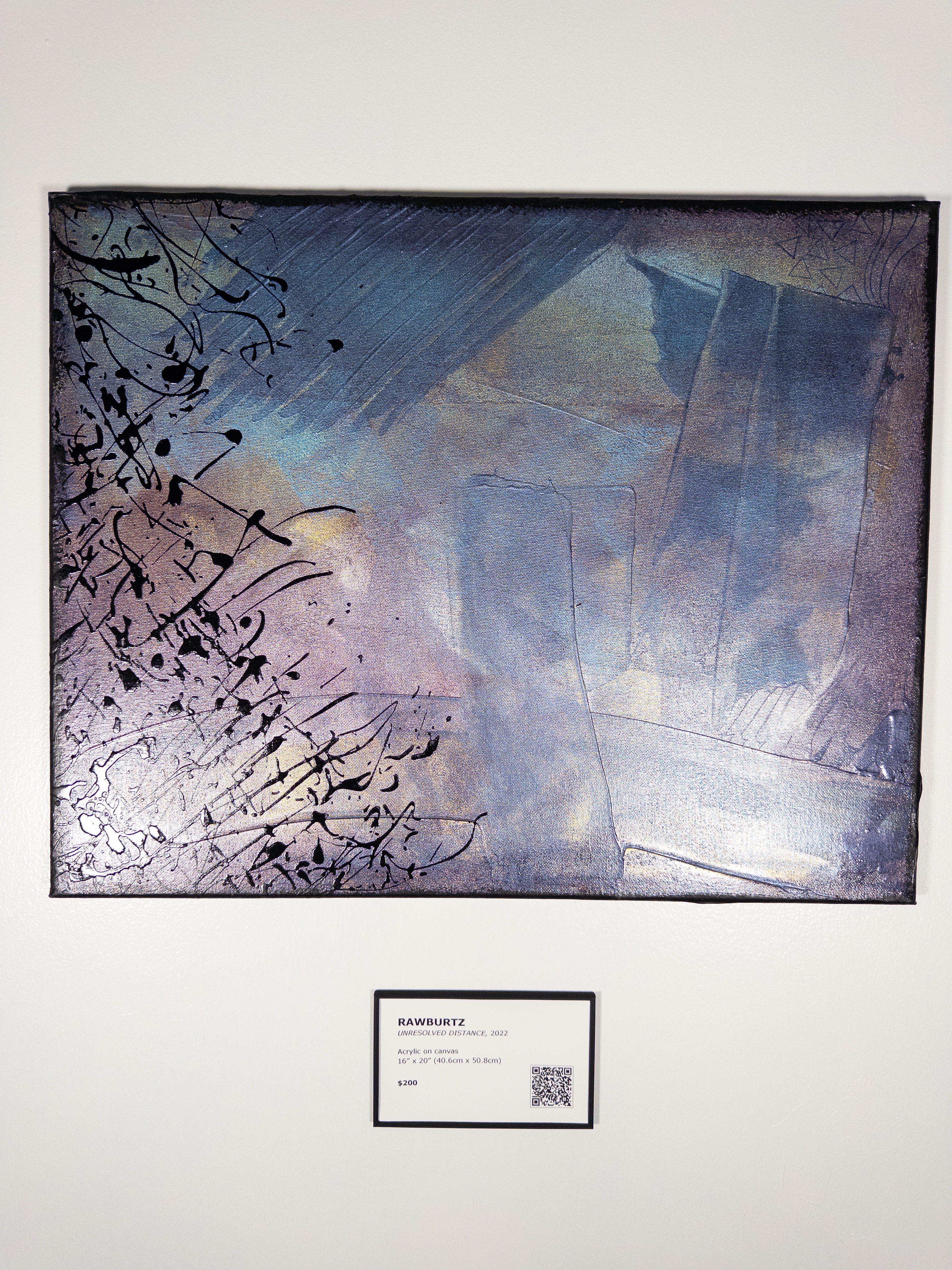
A quiet field of shifting blue, violet, and metallic color is interrupted by restless black linework and distant geometric forms. UNRESOLVED DISTANCE exists between collision and separation—the uneasy space where something remains present without ever becoming fully reachable.

Medium
ACRYLIC
Dimensions
20 × 16 × 0.65 in
Year
2022
SKU
RBZ-3AGX-K88U
Orientation
Landscape
Framing
Unframed
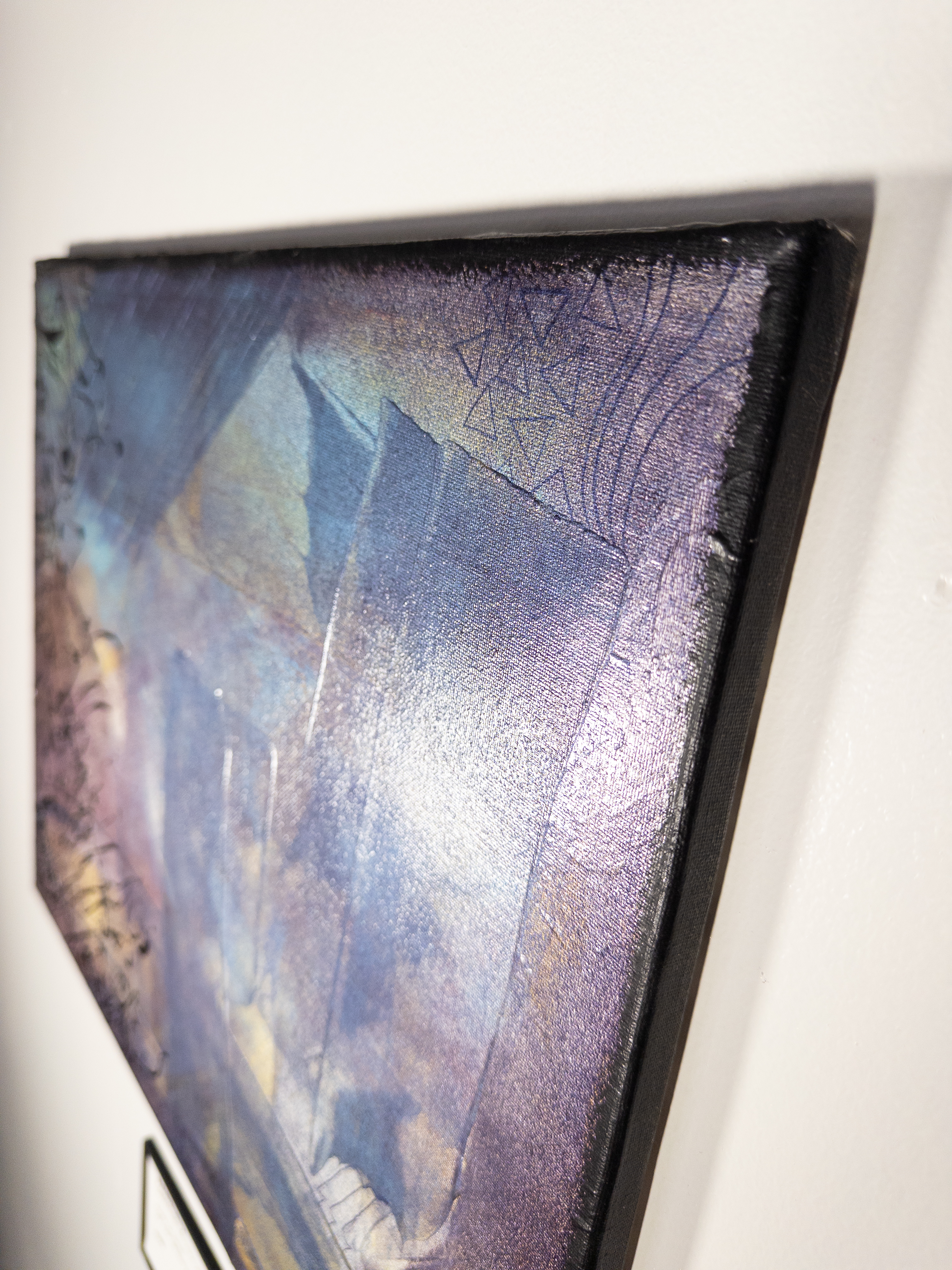
UNRESOLVED DISTANCE is an original acrylic painting built around contrast: movement against stillness, density against openness, and immediacy against something that seems perpetually farther away. Across the left side, black marks accumulate into an energetic network of splashes, fragments, curves, scratches, and interrupted gestures. They feel active and insistent, pushing inward from the edge of the canvas. Opposite them, larger translucent forms emerge more slowly from layers of blue, violet, silver, muted gold, and atmospheric grey. The surface changes considerably with light and viewing angle. Areas that initially appear subdued reveal an iridescent quality as the viewer moves around the work, allowing cooler blues to transition toward violet, pearl, and warmer metallic undertones. Faint geometric structures remain partially submerged within these shifts, appearing almost architectural without resolving into a specific place. The composition never completely reconciles its two sides. One reaches. One recedes. Between them remains an atmospheric middle ground that neither closes the distance nor allows it to disappear.

Beyond the object

The record behind the work.

The work

Story

There are distances measured in feet, miles, years, or geography.

And then there are distances for which measurement becomes useless.

Two people can occupy the same room and remain impossibly far apart. Something from years ago can feel closer than what happened yesterday. A thought can remain within reach for an entire lifetime without ever allowing itself to be completely understood.

UNRESOLVED DISTANCE lives inside that contradiction.

The dense black activity along one side behaves almost like an attempt at contact—signal after signal sent outward, accumulating because no single gesture seems sufficient. Across from it, the larger forms remain visible but indistinct. They are not absent. That may be what makes the distance more difficult.

There is something there.

It simply refuses to become fully accessible.

The work does not attempt to solve that separation. Instead, it leaves the space between the two conditions intact.

Because some distances are not problems waiting for solutions.

Some simply become part of the architecture of being human.
The making

Process

The painting develops through multiple layers of acrylic, allowing translucent and semi-opaque passages to overlap rather than resolving the surface into a single uniform field.

Broad applications of blue, violet, grey, silver, and muted warmer tones establish the atmospheric foundation. Portions of these layers remain visible beneath later applications, creating subtle changes in depth and color depending upon the direction of light.

Larger geometric and architectural forms are worked into the right side through overlapping planes, softened boundaries, drawn contours, and partially concealed shapes. Rather than being rendered as solid objects, they remain embedded within the surrounding field.

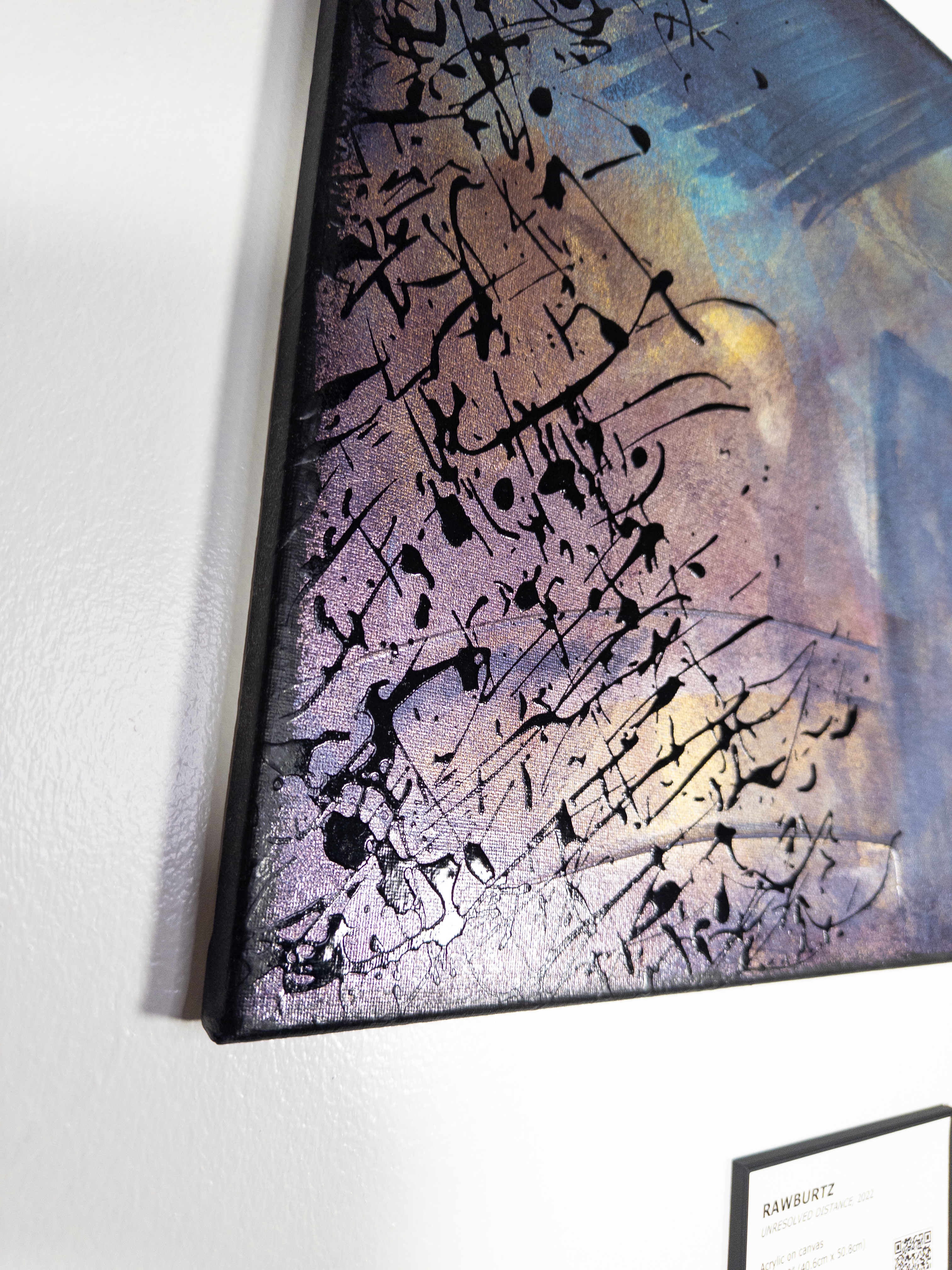
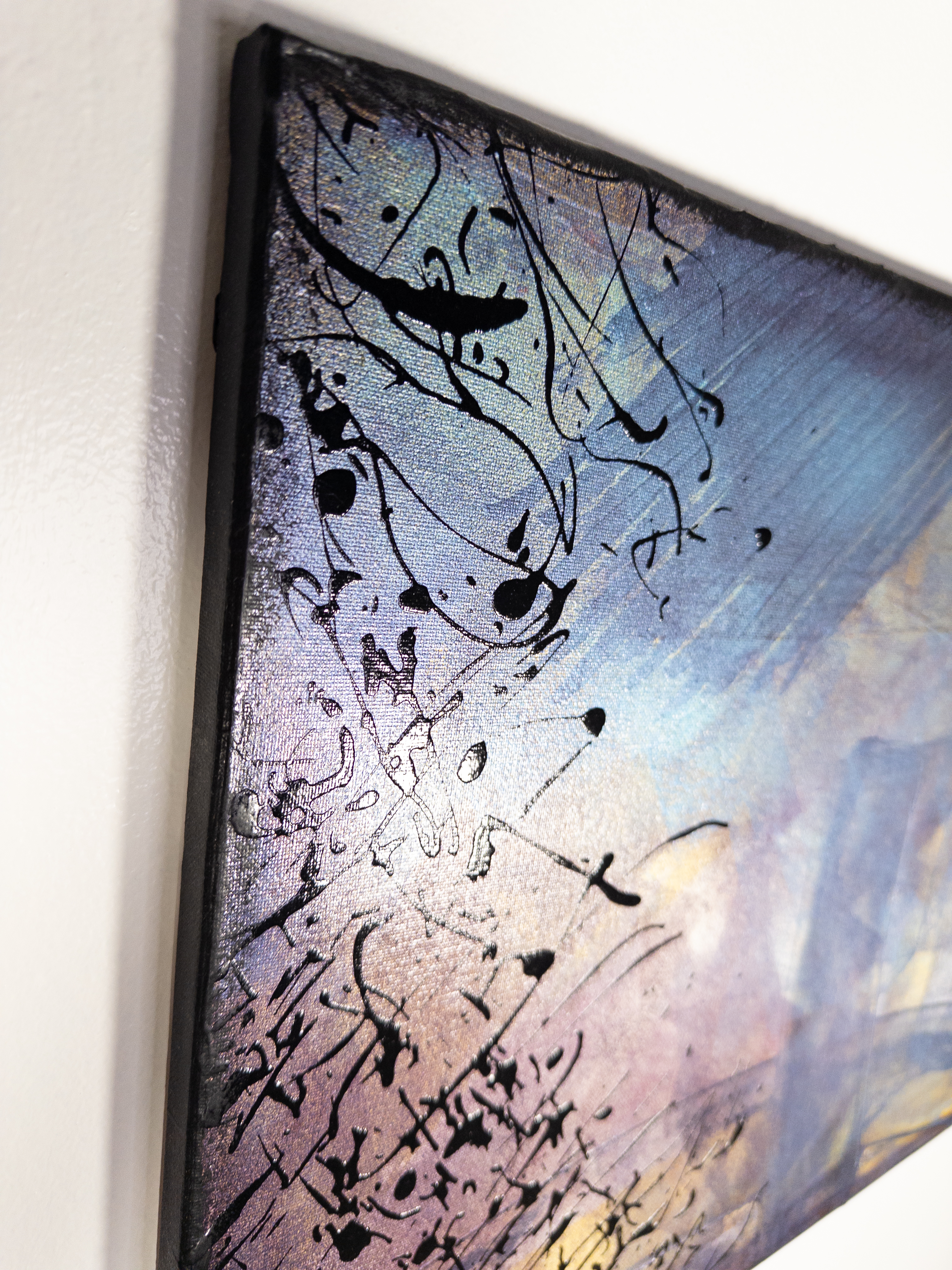
The left side is treated much differently. Fluid black acrylic marks, splashes, linear gestures, loops, drips, and smaller interruptions accumulate into a concentrated area of visual activity. Fine incised and drawn elements appear throughout the surface as quieter secondary structures.

These contrasting methods—controlled layering and spontaneous mark-making—are allowed to remain visibly separate. The process does not force them into resolution; their inability to completely merge becomes part of the finished composition.

For the collector

Collector Notes

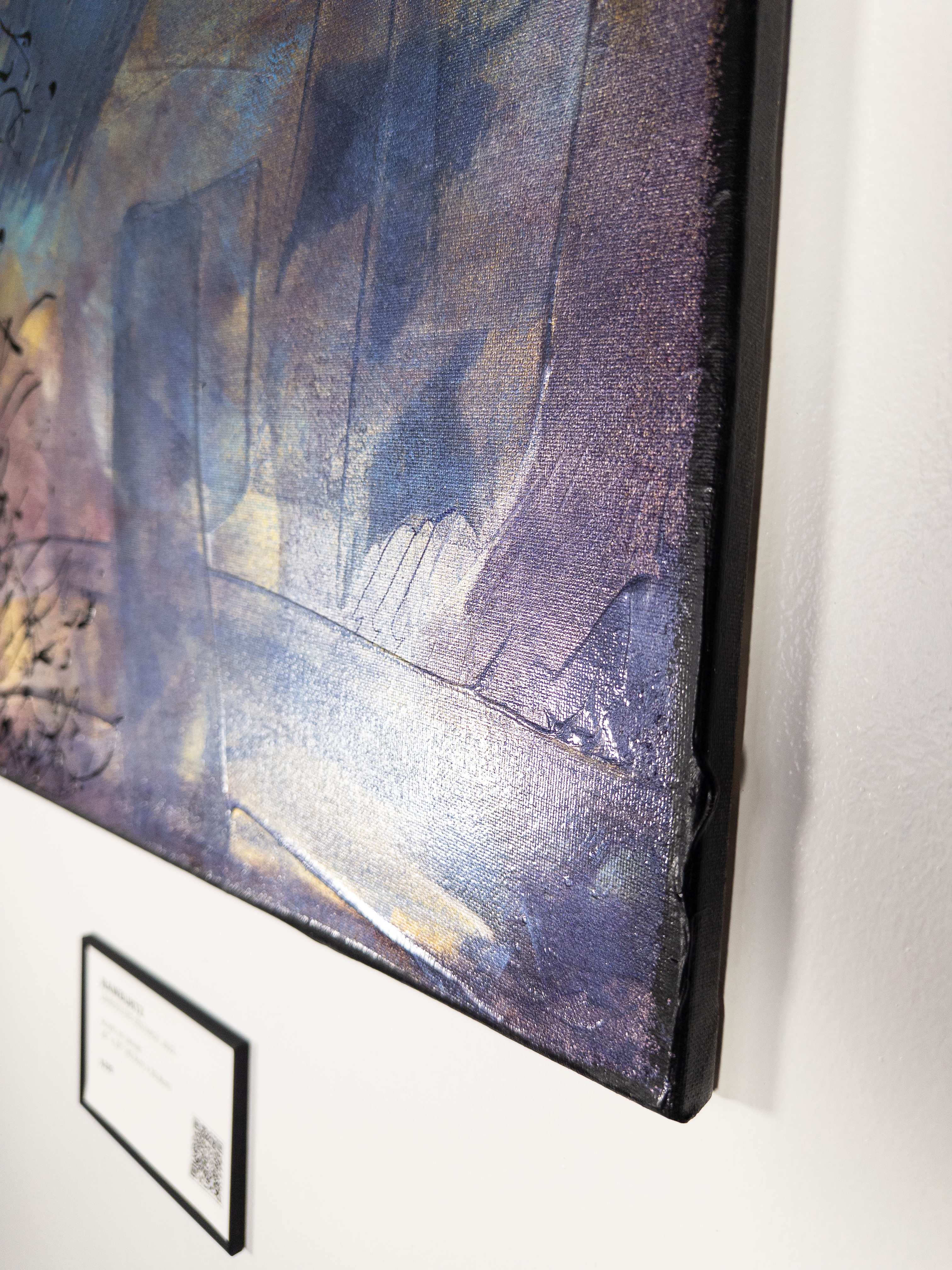
UNRESOLVED DISTANCE rewards changing proximity.

From across a room, the work reads as an atmospheric composition dominated by cool blue-violet tones, with the black marks on the left providing a strong visual anchor. At closer distances, smaller gestures, overlapping contours, scratches, hidden geometric structures, and changes in surface become increasingly apparent.

Its reflective and pearlescent qualities also make the painting highly responsive to its environment. Natural daylight, warmer interior lighting, and directional illumination can each reveal different relationships among the blues, violets, silvers, muted golds, and underlying textures. Because of this, the work does not present exactly the same image throughout the day.

The black-painted perimeter gives the piece a defined physical boundary while allowing the painted surface itself to remain visually expansive.

Conceptually, this is a work for a collector drawn to ambiguity rather than explanation: separation without complete absence, connection without arrival, and the strange persistence of things that remain important precisely because they were never fully resolved.

Look closer

Object study.

Surface, edge, scale, mark, and reverse—the work considered as a physical object.

UNRESOLVED DISTANCE
01 OBJECT
UNRESOLVED DISTANCE
02 CONTEXT
UNRESOLVED DISTANCE
03 DETAIL
UNRESOLVED DISTANCE
04 DETAIL
UNRESOLVED DISTANCE
05 OBJECT